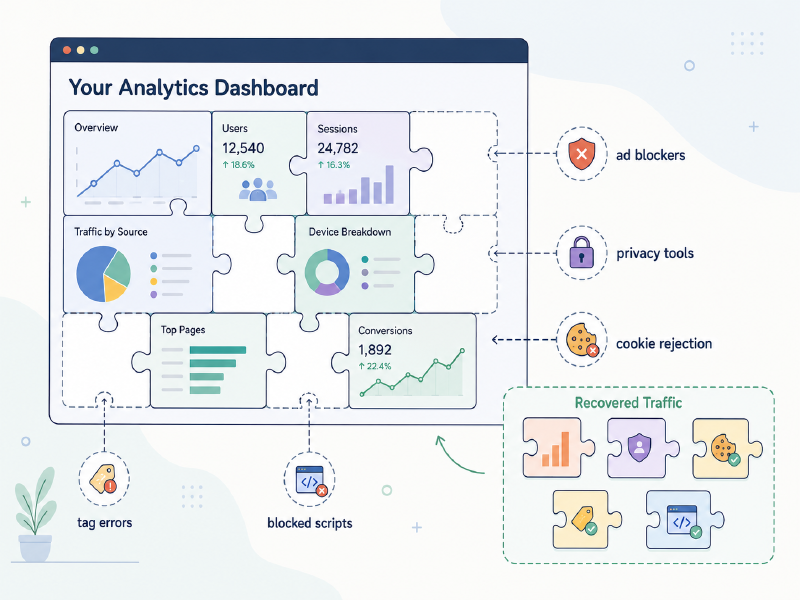
The future of publisher advertising is not bigger audiences - it’s better audience proof, engagement and visibility. Advertisers still want targeting. They still want to reach decision-makers, specialist buyers, policy audiences, industry professionals, wealthy consumers, technical teams, regional markets and niche communities. But the way publishers prove that audience has changed.
The market is moving away from easy yet creepy and questionable third-party tracking1 and toward privacy-by-design measurement. IAB’s 2024 State of Data report found that 95% of advertising and data decision-makers at brands, agencies and publishers expected continued signal loss and privacy legislation. About 90% of ad buyers were also changing personalisation tactics because of privacy constraints and signal loss.
That creates a clear opportunity for publishers. The winner is not the publisher that tracks people most aggressively but the publisher that can prove, responsibly and credibly2, that it reaches the right audience without compromising or alienating that audience.3
Different audiences read different things 
Audience demographics are not evenly distributed across content, channels or formats. Pew Research found that news consumption varies by age, gender, race, ethnicity and education. Americans aged 50 and older are more likely than younger adults to use television and print for news and less likely to use digital sources such as social media or podcasts.4 Pew also found that about half of U.S. adults get news from social media at least sometimes, with social media playing a particularly important role for younger adults.5
The same pattern appears in the UK. Ofcom reported that online news consumption increased from 64% in 2018 to 70% in 2025, putting online news on a similar level to TV and on-demand news.6 Reuters Institute’s 2025 Digital News Report also found that video-based news consumption continues to grow, with social video becoming a more significant route to news, especially among younger groups.7
This matters for publishers because “audience” is not one thing. A financial analysis site, a regional business publication, a cybersecurity blog, a healthcare policy outlet and a luxury lifestyle magazine all attract different commercial audiences.8
Advertisers know this. They do not just buy impressions. They buy context, access, trust and audience fit.9 Talking to their ICP directly returns a far higher ROI than blanket advertising across irrelevant audiences.
The targeting problem publishers need to solve 
For years, advertising addressed targeting with third-party biscuits, behavioural profiles, retargeting pixels and platform-owned identity graphs.10 That model gave advertisers reach, but it also created privacy risk, data leakage, attribution confusion and dependence on ad networks.11
Not only that, but it allowed the large tech firms to charge clients and publishers to grade their own homework. This has lead to an eternal paradox of continuously inflated attribution with big tech firms hosting or proxying content from publishers, polluting the landscape with malicious advertising, hiding traffic and then declaring proudly that they’re responsible for 140% of conversions, clicks, impressions and more.
Publishers need a better model. A publisher should be able to say:
Our publication reaches the audience you care about.
Not by exposing individual readers, by building shadow profiles or by selling user-level surveillance. But by proving aggregate readership patterns across content organisation type, network source, geography, industry and engagement, cleanly and wholly.
The publisher needs to prove the audience, the advertiser needs to prove the person. With this approach publisher analytics becomes commercially useful and serves the publisher.
Privacy-respecting network intelligence 
A publisher does not always need to know who a person is. Often, the more commercially useful question is broader: Which organisations, sectors and networks are reading?
For example, a publisher may be able to show that a meaningful share of readership comes from government networks, universities, major company head offices, banks, healthcare systems, legal firms, technology vendors, public agencies or enterprise office networks. Providers describe this as company- or organisation-level matching. IPinfo says IP data can be used to match business web traffic to a company name and domain, not to individual people.12
Attempting to search out individuals is the realm of invasive and malicious actors. The UK ICO notes that online identifiers, including IP addresses and biscuit identifiers, may be personal data depending on context.13 So for a clean publisher who wishes to retain their reputation as a trusted voice needs to talk knowledgeably about their audience whilst respecting their users.
Used properly, network-level analytics can give publishers commercial proof without turning readers into personal dossiers. Your partners will have everything they need and your users are protected.
What this looks like in a publisher sales story 
Truly Analytics provides this enhanced network information alongside analytics recovery as our Network Intelligence service.
Using Truly Analytics a publisher not only gets to recover their full traffic but also provably their customers and partners which Government networks are regular visitors. Truly Analytics can provide all the knowledge directly in Google Analytics to back up statements such as:
Our finance and compliance content reaches readers from banks, regulators, insurance firms, investment platforms and legal networks.
Our cloud, cybersecurity and digital transformation content is read by enterprise head office networks, technology vendors, consultancies and public-sector organisations.
That is a stronger sales story than generic traffic. It tells the advertiser that the publisher does not just have readers. It has the right readers.
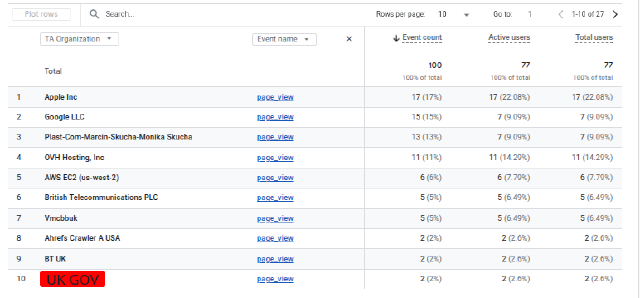
How Truly Analytics supports enhanced publisher analytics 
Truly Analytics gives publishers a privacy-respecting way to see more of their real audience, including traffic that conventional analytics misses. What’s more, Truly Analytics plugs into Google Analytics, so publishers don’t have to replace their stack.
Every piece of analytic data Truly Analytics sees gets enriched and enhanced to the audience level, not the personal level. It does so as a dedicated hosted service for each publisher and passes on the enhanced metrics to Google Analytics without Google ever directly reaching audience devices. This avoids ad-blocking, ensures GDPR compliance, avoids issues with EU/US relations and provides a barrier between your audience and the world’s biggest advertiser.
The strategic advantage for publishers 
Publishers do not need to become surveillance companies to sell targeted advertising. In fact, they should avoid that trap. The attribution nonsense proves it’s inaccurate, it’s unwelcome and it’s heading towards illegality.
Instead publishers should lean into their essence: their advantage is trust, context, editorial authority and direct communication with their audience as a whole. Truly Analytics strengthens that advantage by giving publishers a clearer view of who they reach, what those audiences read and how that attention can be packaged for advertisers without violating reader trust.
For publishers, the next generation of advertising is not “track everyone everywhere.”
It is: prove you reach the right audience, show the evidence, respect privacy and sell the value directly.
Truly Analytics
Recover the traffic Google Analytics is missing
Truly Analytics helps you capture blocked, missing and underreported website activity, then feed cleaner data back into your analytics and revenue systems.
Try Truly Analytics-
IAB Europe and IAB frequently document the industry move toward privacy-led data practices. See IAB State of Data 2024 overview. ↩︎
-
For broader market context on privacy-preserving advertising and first-party/data minimisation approaches, see the UK ICO’s guidance on data protection and privacy expectations in advertising technologies. ↩︎
-
For supporting context, see ANA resources on audience segmentation. ↩︎
-
For background on biscuits and cross-site tracking changes, see Google Privacy Sandbox timeline and the UK ICO’s guidance on storage and access technologies. ↩︎
-
IPinfo, Company Data and IP Intelligence and IPinfo documentation. ↩︎
-
ICO, What are biscuits and similar technologies? and ICO guidance on personal data. ↩︎