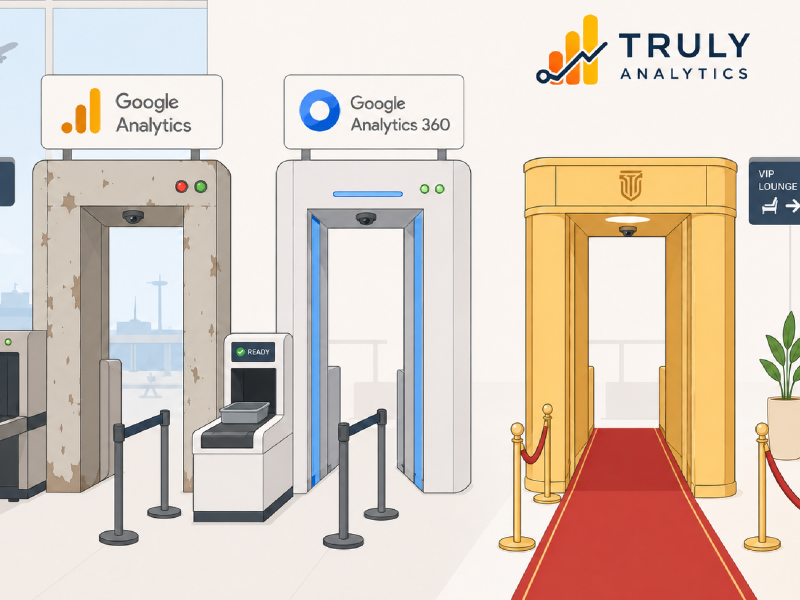
You do not need to replace Google Analytics to get better analytics. In most cases, replacing GA4 creates more problems than it solves. Google Analytics is still the expected analytics platform for most teams, buyers, investors, marketers and operators. It is free, widely understood and often treated as the default source of truth when assessing a digital asset, being offered as an independent auditor from the world’s biggest advertiser.
However, it does have it’s problems with the biggest issue being that Google Analytics is often incomplete.
A better approach is to keep GA4, improve the data going into it and sharpen your event strategy. That gives you the benefit of the analytics platform everyone already knows, without living with it’s negatives.
Here’s three practical ways to improve Google Analytics so that it works for you:
- Recover blocked traffic.
- Manage events properly.
- Implement event hooks.
Recover blocked traffic into GA4 
Your Google Analytics traffic is almost certainly being blocked.
That does not mean your site is broken. It means a growing share of users block Google scripts, ad trackers, third-party analytics, intrusive advertising infrastructure or anything that looks like surveillance. This is especially common among technical users, security-conscious users, privacy-aware users and users inside stricter organisational environments.
That matters because those blocked users are often some of your most valuable visitors.
A user who blocks Google Analytics is not necessarily a low-quality user. They may be a technical buyer. They may work in cyber security. They may be browsing from a large organisation. They may be using a corporate network, VPN, hardened browser or privacy-focused setup. In one cybersecurity case study, standard analytics missed 91.4% of the audience and recovered traffic increased by 11.7x. In other words, the missing traffic may include exactly the audience you most need to understand.
If GA4 does not see them, your reporting is distorted. You may underestimate demand. You may misjudge which pages are working. You may miss signs that a major organisation is researching you. You may think content is underperforming when it is actually reaching a valuable but blocked audience.
Truly Analytics improves GA4 by recovering blocked traffic and sending that visibility back into Google Analytics whilst protecting these users privacy from Google. Instead of tackling this massive issue directly and often asking your team to abandon GA4 and learn a new dashboard, Truly Analytics sorts this issue directly.
The result is that you get to keep GA4 whilst not suffering blindly because Google is rightfully blocked by your users. With this recovered traffic you now have insights into data and activity you never previously had
Before replacing Google Analytics, ask a simpler question:
Are you sure GA4 is seeing the traffic you already have? In many cases, the answer is no.
Keep your event strategy focused 
A common mistake in analytics is assuming that more events and more event parameters means better analytics. It does not.
Tracking everything can make your reporting worse. You end up with too many events, too many parameters, inconsistent naming, unclear definitions and reports that nobody trusts. Additionally, in the modern age with running all that data through machine learning and other statistical systems a larger set of data can lead to increased opportunities for over fitting, phantom
Good analytics needs a strategy. You need to know what you are trying to understand before deciding what to track. That usually means answering practical questions:
- What actions show buying intent?
- What actions show product interest?
- What actions show content engagement?
- What are the corresponding data parameters that relate to these actions?
Once you know that, you can keep your GA4 events focused keeping you within the GA4 limits and giving you a cleaner analysis. If an event does not support reporting, targeting, automation or decision-making, it probably does not need to exist. If parameters are not standardised across your customer journey then they cannot be correlated throughout the entire flow.
A focused event strategy gives you:
- Cleaner reports.
- Better attribution.
- Easier debugging.
- Lower risk of hitting GA4 limits.
- Better continuity across campaigns.
- More useful audience definitions.
- Less confusion between marketing, sales and leadership.
Track the things that matter, name them properly and make sure the data supports decisions.
Improve GA4 with Event Hooks 
The next step is to make events useful outside analytics. Most analytics systems treat events as reporting data. A user does something, the event goes into the dashboard and someone looks at it later. This is useful, but limited.
What’s better is when events tie into other automated systems allowing analytics events to carry that data downstream automatically. We built Event Hooks into Truly Analytics to do this, making analytics events the start-of-funnel hooks that can then move into connected CRM systems and wider GTM automation.
Instead of being a passive reporting layer, the analytics became the tip of the spear for our revenue funnel.
For example, an event hook can support:
- CRM enrichment.
- Sales follow-up.
- Account monitoring.
- Lead scoring.
- Content performance alerts.
- Internal notifications.
- Segmented user analysis.
- Targeted content monitoring.
- Automated workflows based on user behaviour.
This is especially useful when combined with recovered traffic as you have a fully visible funnel moving from top to bottom. Truly Analytics’ Event Hooks makes meaningful behaviour actionable automatically creating a more responsive system.
Why this is better than replacing GA4 
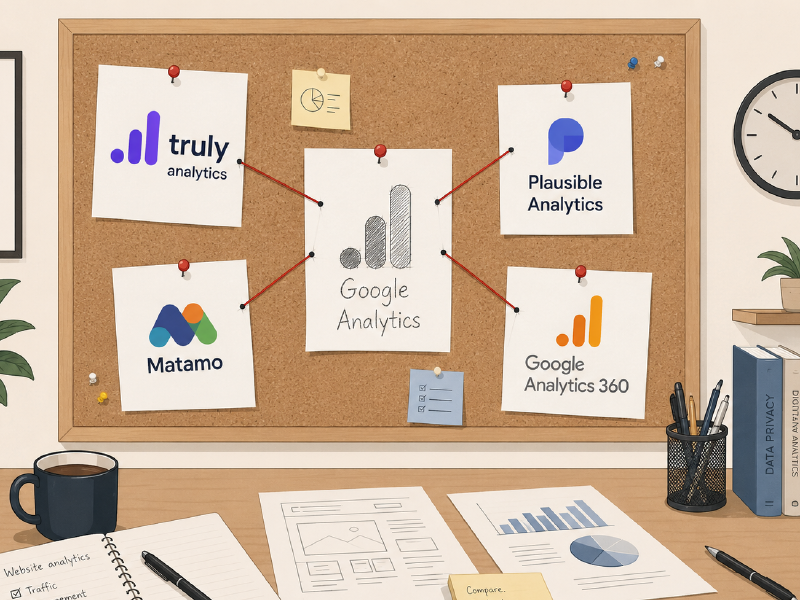
Replacing GA4 can make sense in some cases. If you need a fully independent analytics platform, a privacy-first analytics tool or a self-hosted system, then alternatives such as Plausible or Matomo may be worth considering.
But for most organisations, removing GA4 creates friction. Teams already understand GA4, stakeholders expect it, agencies know how to work with it, buyers and investors ask for it. Marketing tools integrate with GA and not with the others. Standard reporting processes are already built around GA4 reports.
The better question is:
How can we make Google Analytics more complete, more focused and more useful?
Keep GA4 as the standard reporting layer. Use Truly Analytics to recover blocked traffic. Clean up your event strategy so reports stay clear. Add Event Hooks so important behaviour can trigger action.
That gives you a stronger analytics setup without forcing the organisation into a full platform migration.
The right approach 
First, recover missing traffic. If GA4 is not seeing your audience properly, every downstream report is weakened and you’re running blind.
Second, clean up your events. More data is not automatically better data. Your events should match your strategy, targeting and reporting needs. Once you have visibility you’re not scrambling for data so you can afford to be lean and efficient.
Third, implement Event Hooks. Once you know which events matter, connect them to automations, monitoring and CRM workflows. Now your analytics system is a core revenue stream and not just a metric.
That gives you a better version of Google Analytics without replacing GA4.