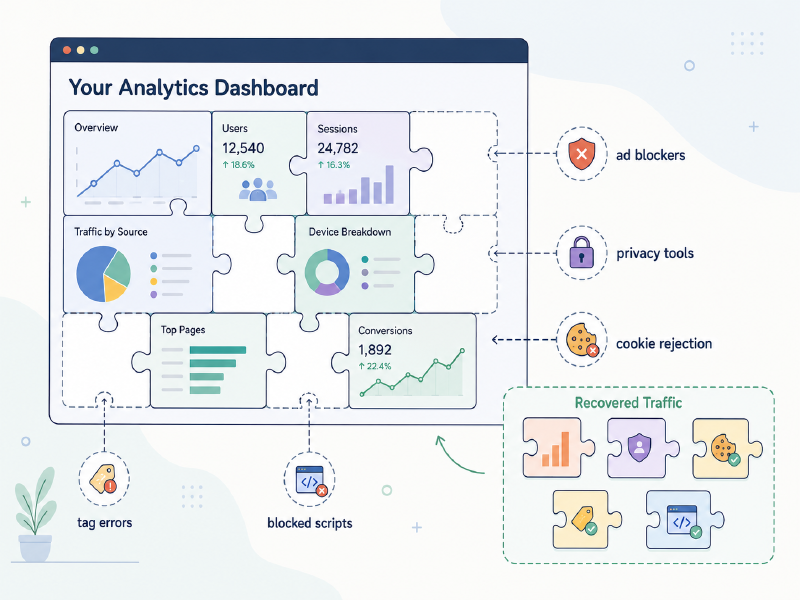
For publishers, analytics is not a reporting layer, it’s the commercial reporting layer. Publishers use it to prove readership, demonstrate audience growth, sell advertising, price direct campaigns, support sponsorships, justify partnerships, understand editorial performance and show the public and the market that their publication has influence.
It’s also how publishers measure up against each other.
Analytics is a core part of how a publisher proves value. If the audience is undercounted, the publisher is not just missing a metric, they’ll be underselling their reach, weakening their media kit, misjudging editorial performance and leaving revenue on the table.
Page views matter 
Page views are not the only measure of publisher value, but they remain one of the most important commercial signals. For Google Analytics, the page_view event is usually collected when a page views or when the browser history state changes. Page views are the basic unit of web publishing measurement.
For advertising, page views connect directly to monetisation. Google AdSense defines Page RPM as estimated earnings divided by every 1,000 page views. Every counted page view contributes to how much money their pages generate.
Publishers also use traffic metrics to present themselves to advertisers. Media kits commonly include monthly unique users, sessions, page views, audience demographics, location and engagement data because these are the numbers advertisers use to judge whether a publication is worth buying from. Large publisher media kits make this plain: the Los Angeles Times promotes monthly unique visitors and monthly page views, while Newsweek promotes global unique visitors, page views, business decision-makers, C-suite executives, income and social reach.
The same logic applies to public publisher rankings. Similarweb ranks news and media publishers by traffic and shows engagement measures such as pages per visit, visit duration and bounce rate. Comscore describes itself as a currency for planning, transacting and evaluating media, while also treating unique visitors and visit frequency as measures of reach and loyalty.
Your Google Analytics provides the realtime commercial ranking of your publication in the world, using the same language as your customers: reach, readership, visits, page views, frequency and engagement.
The problem: the majority of analytics systems don’t see the full audience 
Publishers rely on Google Analytics because it is the industry standard. But Google Analytics is a Google service and Google services are usually blocked by privacy tools, browser protections, ad blockers and network-level filtering.
This is not a niche issue. Plausible found that 58% of visitors from tech-heavy audiences such as Hacker News and Reddit blocked Google Analytics in one test, showing how heavily the missing-data problem can depend on audience type. Eyeo and Blockthrough projected that ad blocking would cost publishers $54 billion in lost ad revenue in 2024, which shows how materially blocking behaviour can affect publisher economics.
Our own case study is more extreme - a boutique cybersecurity firm had 91.4% of their analytics blocked via a standard Google Analytics installation.
For publishers with technical, security, finance, government, enterprise, developer or privacy-conscious audiences, the undercount can be especially damaging. The more valuable the audience, the more likely it may be to use strict browsers, corporate networks, security tools, VPNs, ad blockers or privacy extensions.
The audience most valuable to advertisers are often the audience least visible to conventional analytics.
What analytics recovery changes 
Recovering analytics does not magically create new readers. It does something more useful: it reveals the readers who were already there. You don’t want new readers as much as you want the readers who are already engaged.
That difference matters.
If a publisher is actually receiving 40% more traffic than its Google Analytics dashboard shows, they’ll be undervaluing its inventory. If key articles are being read by enterprise, government or specialist-sector audiences but those visits are not captured, the publisher will be failing to package valuable editorial categories for advertisers. If direct campaigns are being measured through partial tracking, sales teams will underreport performance and weaken renewal conversations.
Truly Analytics is designed around that gap. Instead of depending on Google’s advertising network and standard third-party analytics paths, it gives publishers a more complete view of real website activity. For publishers, that means recovered visibility, improved campaign evidence and stronger proof of audience value.
The core benefit is simple: private, direct analytics without being blind. If your users want to block advertisements and Google then we respect that, but you don’t have to have your traffic sacrificed in the crossfire.
How better analytics improves publisher revenue 
Better analytics affects the bottom queue in three main ways.
First, it improves packaging. When a publisher can see which sections, topics, authors, pages and campaigns generate real traffic, it can build better advertising products around proven audience behaviour. Undercounting a campaign undersells to the next campaign
Second, it improves sales confidence. Direct ad sales depend on proof. A publisher that can show accurate traffic, readership by segment, content performance and campaign activity has a stronger sales story than one relying on partial Google Analytics data.
Third, it improves optimisation. Publishers using deeper ad revenue analytics can identify which traffic sources, content types and ad configurations drive stronger RPM or session value. Playwire notes that sophisticated publishers track revenue across acquisition, content performance, ad strategy and audience dimensions because those are the drivers that actually affect earnings.
There is also real-world evidence that audience growth and digital engagement affect publisher financial performance. The Guardian Media Group reported 2024/25 revenue growth driven by increased digital engagement, with digital reader revenues up 21.7% and digital recurring supporters reaching 1.3 million globally. Groupe Le Monde reported stable 2025 revenue and profits despite a difficult ad market, done so “above all” by strong readership growth, video growth, podcast growth, liveblogs and digital subscriptions.
The conclusion is straightforward: publishers that improve readership, measure it accurately and convert it into commercial products are better positioned to grow revenue. They’re also going to support stronger actual readership and compete strongly.
Why continue to compete with under counted metrics?
Be at the forefront of modern analytics 
Modern publisher analytics needs to measure total readership, recover missing traffic, segment audiences, connect campaigns to revenue, show content performance, support direct sales and feed data into CRM and commercial workflows.
Truly Analytics moves publishers from passive measurement to commercial intelligence. It recovers the missing analytics they need, prove the real scale of their audience and turns that visibility into sales material for direct advertising, sponsorship, custom campaigns and market positioning.
For publishers, analytics is the health of their business. It is how the business proves influence, sells access, defends pricing, improves content and turns readership into revenue.
Truly Analytics
Prove your audience
Built to fix the issues plaguing publishers for decades, Truly Analytics is the solution publishers have been asking for.
Try Truly Analytics