I would simply call it an automation tool: a human-friendly, well-packaged automation tool.
Truly Digital has a long history in automation, beginning with cloud automation. The focus was on using the cloud efficiently, not lifting and shifting systems and leaving clients with a build on Amazon that cost five times more. Instead, we used cloud technologies such as load balancers and functions as a service to batch work effectively. In some cases, customers ended up with no cloud bills at all through careful use of free tiers and very light, efficient technology usage.
That approach gave them room to test multiple ideas, everything from POCs to launching campaign websites at short notice. It also helped create operational efficiencies that supported their sales and regulatory compliance, particularly as new regulations and client requirements continued to come through with increasingly obnoxious timelines.
The small bit of time spent on automation allowed for a whole new set of possibilities, a huge Pareto Advantage.
What Does AI Content Actually Do? 
AI content is also an automation tool. It takes a set of data and calculates the next most likely set of data given the patterns it recognises in the given data, based on the training data it has calculated already.
In human terms, if you provide an AI with the text “Hey how are you?” - the LLM should recognise the strong correlation that this text is almost always followed with “Fine thanks, how are you?”. Text is just data and relationship patterns can be calculated just as easily as any numeric data.
So if you can nail the 20% going into the AI machine then you’ll be able to leverage success out of the 80% that AI produces on the other side.
AI Alone Won’t Cut It 
As an automation tool, AI only offers leverage. That is why, in the early days and even now, AI is poor at saying “I don’t know.” It can only calculate from data that exists and from patterns that follow on from that data. It cannot easily calculate a follow-up where no answer exists.
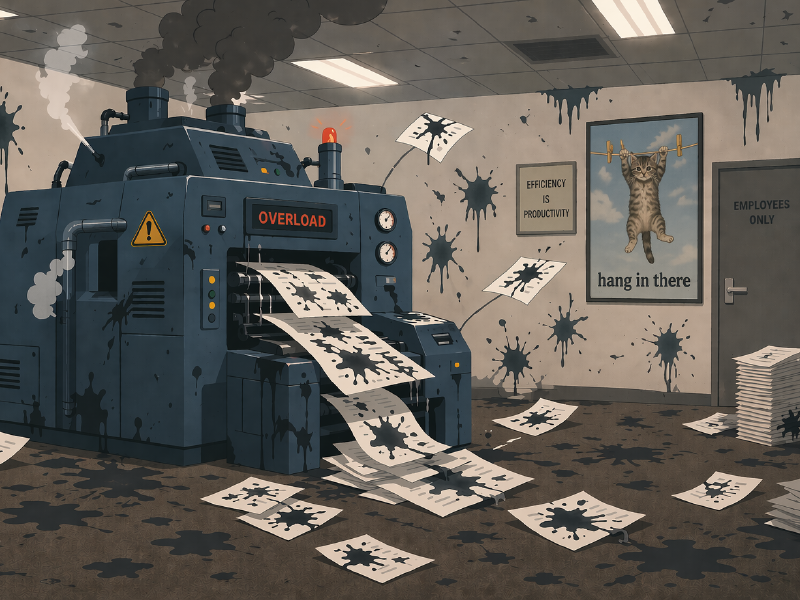
Many complex ideas have not been automated because they do not have a known answer beyond logical calculation. “The meaning of life is 42” is the pop culture example from The Hitchhiker’s Guide to the Galaxy. There is follow-on data from asking what the meaning of life is, because there is no established answer or data beyond the question itself. So the answer you get is nonsense. If you feed in nothing to the AI machine you’ll get nonsense or at best a deviation to the mean as output.
Putting in a small bit of unique effort at the beginning will leverage AI substantially.
With that in mind...
AI should be treated as an automation tool and large language models specifically as a way to automate content generation.
They are not there to automate expertise or produce something valuable out of nothing. What you are doing is taking a core, useful, unique, authoritative idea and automating the text that describes it, establishes it and demonstrates your authority in that area.
In practical terms, creating a load of content with AI alone is not the point. The better use is generating 80% or more of the content from a core idea or concept that only you can know as an authoritative source and expert in that field. That is the effective way to use AI, not by producing a load of rubbish or generating content for its own sake.
Can AI Make You an Expert? 
It is an automation tool for getting what you know onto the page and getting you there faster. It does not make you an expert in whatever you claim to be an expert in.
That is why Truly Digital starts by identifying what is actually valuable in your business and then uses AI to help build authoritative content around it. We do not use AI to make you into something you are not. We use AI to get you 80% of the way there, then apply our expertise to complete the remaining work that sets you apart.
Why the Final 20% Still Matters 
Anyone can now produce the first 80% of content by generating the words themselves. What most do not do is the additional work that drives meaningful return and makes clients choose you over other options they may have inherited or reviewed elsewhere.
Those efficiencies are exactly how you win in business.