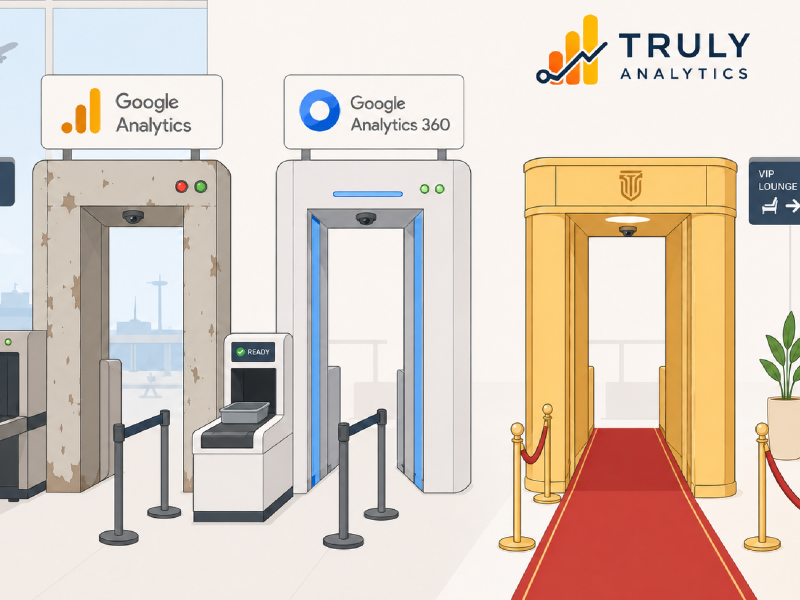
Alternative to Google Analytics 
Google Analytics is Google’s free analytics software originally acquired as Urchin many years ago. Google has always tied Google Analytics closely to its advertising services with its core focus being to provide analytic insights to help advertisers trust and attribute their ad spend. To do this Google provides Google Analytics as a free product with in-built advertising attribution. You can’t beat free and as such Google Analytics is the standard analytics service for almost any digital asset.
Because it is free, Google Analytics tends to crowd out the wider analytics market. As a result, most buyers and operators of digital assets rely on it and expect it as the de-facto independent analytics attribution for a digital property. Access to a Google Analytics property is now a routine part of merger and acquisition due diligence for validating traffic claims, event attribution and other core parts of online commerce.
However, Google Analytics is built primarily to support Google’s advertising system. At its core, it is not necessarily intended to provide complete analytics. It is intended to provide analytics that support ad attribution. That matters more now because the advertising environment is becoming less accessible. Ad blockers are often recommended for security reasons - web advertising has become intrusive and malicious enough to drive wider ad blocker use. De-Googling has become a standard practice for some users who want to limit Google’s presence in their lives. More generally, anti-Google sentiment is more common now than when Google Analytics was first released.
Depending on your use case and your audience, Google may be actively blocked by your users. That can leave you with analytics that are materially incomplete. In every case where we have deployed Truly Analytics, visibility increased because of the widespread use of anti-Google technology. One of the strongest returns came from a cyber security property, where traffic increased by 11.7x after standard analytics missed 91.4% of the audience.
In this article, we set out options for moving away from Google Analytics, along with reasons to keep using it. The aim is to give you enough information to make a sound decision.
What is the best alternative to Google Analytics? 
Top alternative: Google Analytics improved with Truly Analytics 
The benefits and drawbacks of Google Analytics are easy enough to find. One of its strongest advantages is simple inertia. Google Analytics is the industry standard and that status is reinforced by the fact that it is free and widely used. There few reasons to not run it, because it gives you a service that the rest of the industry already uses and trusts without requiring a cost.
Even if you want to move away from Google Analytics, it rarely makes sense to remove it entirely. Doing so means removing something free that will still be expected whenever your traffic and the value of your digital asset are evaluated. Not having Google Analytics can appear suspicious, even if you use another tool from the list below.
Because you are expected to have Google Analytics, it makes sense to use a service like Truly Analytics to improve it, to get it to work for you as an analytics tool and not for Google as an advertising tool. Truly Analytics gives you a fuller view of your audience directly inside the world’s most widely trusted analytics tool, while also adding further functionality such as Event Hooks and privacy management.
This lets you go beyond what Google Analytics provides, not only in traffic volume recovered, but also in what you can see in that recovered traffic. You can identify how many users are coming from VPNs, how many are coming from major institutions including government bodies and other large entities and how much of your traffic is coming from mobile connections regardless of device type.
In addition, managed customers receive direct analytics advice and guidance. Once your traffic is recovered, you can get support on what that means for your business and how to turn that added visibility into useful value for the organisation. Having immediately visibility of over half your audience restored opens up new opportunities that are worth exploring with an analytics partner.
It almost never makes sense to abandon Google Analytics, given that it remains the industry standard. It does make sense to make it work for you, rather than accept its limitations as fixed.
- Keep GA4 as the source of truth.
- Restore blocked or missing traffic into the tool the team already uses.
- Avoid retraining teams on a new analytics dashboard.
- Add consent-aware visibility, automation hooks that can move start-of-funnel analytics events into CRM systems, and user or network segmentation.
- Best for teams that like GA but no longer trust its completeness.
You should keep Google Analytics but make it work for you. Use Truly Analytics to enhance your GA first then explore options
Google Analytics 360 
Google Analytics 360 is the enterprise version of Google Analytics, where you work directly with Google. It is less compelling than Truly Analytics in this context because every Google Analytics 360 engagement requires direct contact with Google for a personalised quote, which introduces procurement friction and working with Google’s client teams. In every case we have seen, GA 360 costs substantially more than Truly Analytics.
That said, if your GA reporting depends heavily on the tools provided broader Google Cloud suite, then Google Analytics 360 may be necessary. It exists to provide expanded limits required for enterprise reporting. In most cases, you do not need Google Analytics 360 until it becomes very obvious that you do as you start hitting limits with BigQuery and be prompted clearly to upgrade.
It is also worth noting that Google Analytics 360 still benefits from Truly Analytics data enrichment. If you already operate at enough scale to require Google Analytics 360, then recovering blocked traffic becomes even more relevant, because you will be bringing in substantially more data and visibility.
One final point is support. Google does not have a particularly strong reputation for support quality as a service provider. That applies not only to Google Analytics 360, but also to Google Cloud Platform and other Google products. There have been public cases of serious account and project issues, including Google accidentally deleting, where resolution required public pressure. It is not pleasant to raise those examples, but the point is practical: Google support is not always dependable.
- Best if the problem is scale, quotas, retention, governance, BigQuery limits and enterprise support.
- A poor fit if the core problem is missing blocked traffic and cost sensitivity.
- You won’t get guidance or Analytics support from Google - not the right pick if you’re looking for non-technical assistance
You'll know when you need Google Analytics 360 as you'll run into limits for Google Analytics reporting and be prompted to upgrade. If you're not hitting the limits then GA360 won't offer much value.
Plausible 
Plausible is a standalone, open-source analytics provider that approaches analytics recovery in a clean and accessible way. It has some of the same blocking issues as Google Analytics when used as a third party managed service and its position on analytics recovery is not as strong as Truly Analytics. Still, it is a good option if you place significant importance on using a fully independent, de-Googled analytics platform.
If you cannot have your analytics associated with or hosted by Google in any form, Plausible is a workable solution. The trade-off is practical. If you use Plausible, you may encounter more friction when valuing or selling a digital asset, because as a service Plausible does not have the same standing in the wider M&A market as Google Analytics. Plausible is not unknown, but will be a point of push back and questions during the process. In practice, you may still be asked why you are not simply running Google Analytics as well, given that it is free.
- Best if the team wants simple, privacy-first web analytics and is happy to move away from GA or Google entirely.
- Not ideal if GA4 reporting, Ads workflows, Looker or BigQuery continuity matter.
Plausible is what you want if you don't want anything to do with Google but still need a third party provider to service your analytics
Matomo 
Matomo goes a step further than Plausible and offers much of what Truly Analytics offers, including the ability to recover missing analytics. What it does not offer is the ability to place those recovered analytics back into Google Analytics. It also requires more setup than the vendor-based options listed above.
You are also likely to encounter more friction with Matomo in M&A contexts. If you run an open-source analytics platform yourself, there is nothing to stop you from fabricating analytics directly as you’ll have full access and ownership of the system and therefore can alter the data & reporting. For that reason, Matomo data is more likely to be treated with caution or disregarded during acquisition review.
That said, Matomo is the right choice if you absolutely need all analytics to remain private and under your own control and no external vendors are acceptable. This is mainly relevant for highly sensitive organisations, such as government bodies and similar institutions, that can and should operate entirely private analytics infrastructure. That is a rare requirement, but it is a real one and Matomo works well for it.
- Best if the team wants ownership, self-hosting, GDPR posture and a full replacement analytics suite.
- More operational overhead than Plausible or Truly.
Matomo is the completely self managed analytics platform but requires full setup and ownership and will face friction during M&A considerations