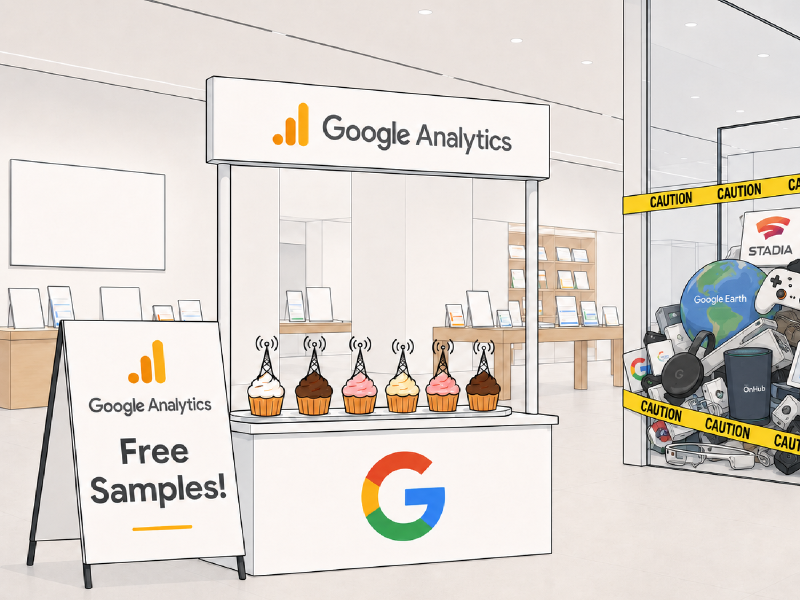
Google Analytics remains the default analytics platform for most websites. It is familiar, widely used, easy to work on collaboratively and generally accepted as a legitimate source of performance data across the M&A space.
But it has a rather large problem: Google Analytics data is almost always incomplete.
For some businesses, the missing data is small enough to ignore. For others, it can significantly distort how the business understands its audience, traffic, conversions and growth. Once you’re made aware of this gap the problem begs the question:
Reasons For 
Google Analytics is the main analytics tool across the whole internet. It provides a common set of features, access and even terminology that the rest of the industry utilises. It’s found on nearly half of all websites out there and included on 80%+ of websites that have traffic analysis tooling. That’s the sort of presence that dictates the industry.
With this in mind there’s already a very strong reason to keep it: it’s the norm.
As it’s the norm not having Google Analytics adds in friction that affects asset valuation, sales process and even a description of size and scope of your site. As a free tool Google Analytics gives a common base ground to all levels of business and to participate easily in the conversation you’d need to have that shared language.
Also as a free tool there’s no commercial objection to not installing the product. There’s good reasons outside of the cost, but free cannot be beaten.
Reasons Against 
One of the main weaknesses of Google Analytics is that it is a Google service.
That matters because Google-owned tracking domains and scripts are commonly blocked by browsers, privacy tools, ad blockers, security software, corporate networks, DNS-level filters and home network blocking tools.
Users don’t consider that it blocks analytics, they simply want to block advertising, tracking, malware risk and privacy-invasive tech. Google Analytics gets blocked at the same time as it’s a service intended to support Google’s Advertising platform. Some users just want to block Google services more broadly, which is also perfectly reasonable.
These reasons are not minor edge cases.
In one Truly Analytics case study for a cyber security firm, over 90% of Google Analytics tracking was blocked.
A cyber security audience is far more likely to use privacy tools, hardened browsers, script blockers, DNS filtering and stricter corporate security settings. So likely that practically all of them do it.
For that user base, Google Analytics was not just slightly incomplete. It was missing most of the audience. On a standard installation it was frankly the wrong tool.
From Google’s point of view, those users are less valuable within its ad ecosystem and therefore less valuable in Google Analytics.
For a website owner, though, this isn’t the same position. Those users still matter. They are buyers, researchers, technical decision-makers and exactly the audience the business cares about most. If they disappear from Google Analytics, the business gets a distorted view of reality.
Weak analytics affects how a business is judged and valued. If your analytics tooling misses a large share of your users, your website appears smaller, weaker and less valuable than it really is.
This issue affects all manner of companies including SaaS, developer tools, B2B platforms, privacy products, crypto businesses, technical publishers, financial services and any brand serving users who are more likely to block tracking.
The business may be performing better than Google Analytics suggests, but with incomplete data the product looks less successful than it is.
Now it’s a business valuation issue.
Why Not Just Replace Google Analytics? 
There are many alternatives to Google Analytics.
Some are privacy-first. Some are simpler. Some are self-hosted. Some are better suited to technical teams. Some are less likely to be blocked because they are not tied directly to Google.
For many companies, those tools are worth considering - we cover a shortlist in our article on Google Analytics alternatives.
You’ll find the usual discussion around features, costs, benefits but you’ll miss one of the biggest most problematic issues with replacing Google Analytics that it seems only we at Truly Digital talk about: trust.
Google Analytics is the industry standard. Agencies understand it. Buyers understand it. Investors recognise it. Marketing teams know how to use it. It is commonly expected in acquisition, growth and performance discussions.
Alternative analytics platforms may produce better or more complete numbers, but outside parties don’t treat them with the same confidence. Alternatives just don’t have the trust level built into Google Analytics for better or worse.
Google Analytics data will probalby be incomplete, but even with its flaws it remains the industry benchmark.
The New & Better Strategy: Improve Google Analytics 
Don’t abandon it - improve it.
This means keeping Google Analytics as the recognised reporting layer, while using a tool like Truly Analytics to recover blocked traffic, improve tracking reliability and manage privacy, consent and functionality in ways standard Google Analytics does not provide.
If you’re stuck with Google Analytics - which you are - make it work for you.
Truly Analytics recovers the traffic that would otherwise be missed, giving businesses better visibility into users who are effectively invisible in standard GA4 reporting. If those users are missing, the data is not just incomplete - it’s biased against your savviest and sharpest customers.
You should try Truly Analytics today to understand the scope of your missing traffic and how that can be solved.
Start your free trial
No obligation, free 3-day trial that runs alongside your current Google Analytics setup